Financing a house flip: opportunities for real estate investors in 2026
Buying a property, renovating it, and reselling it for a profit sounds simple. However, the challenge lies not in finding a suitable property, but in smartly financing the entire process. From the purchase price and renovation costs to transfer tax and selling costs: every component of a house flip requires a sound financing plan.
In this guide, you will read step-by-step how to finance a house flip in the Netherlands. You will discover the costs involved, how to set up a solid business case, and which exit strategy maximizes your return.
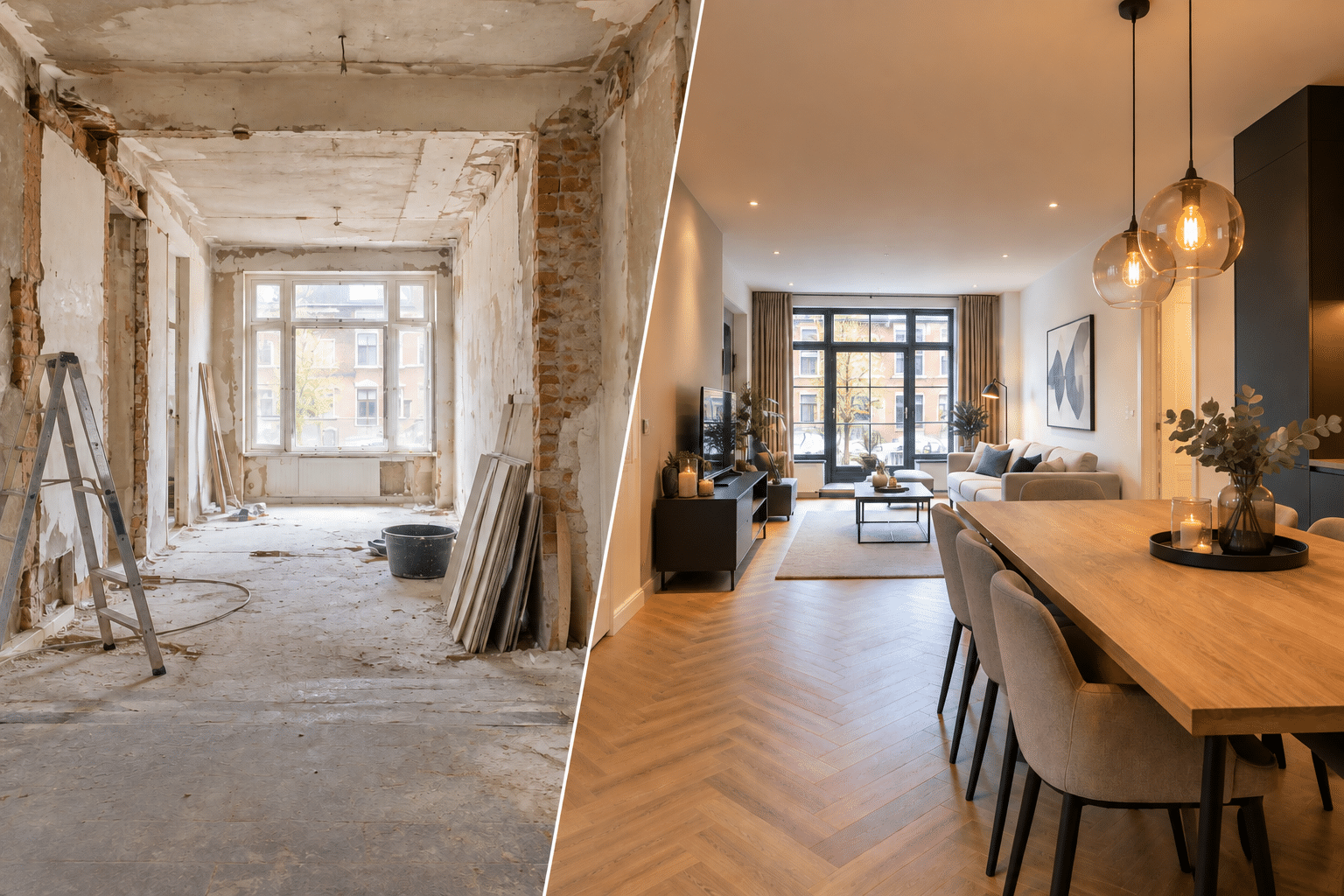

Key Takeaways: financing a house flip in the Netherlands in 2026
The most important points of attention and financing options for successfully financing a house flip in the Netherlands.
- A house flip requires financing for purchase, renovation, additional costs, and a buffer for unforeseen expenses.
- Bridge financing and a construction depot are the two most commonly used forms of financing for short-term flipping projects.
- The actual profit margin is determined by including all costs, including transfer tax and interest.
- A clear exit strategy, whether sale or rental, is essential before you apply for financing.
- Beleggingspanden-Financiering.nl offers tailor-made solutions for flipping projects, often realized in less than one week.
What is a house flip and why is it popular?
House flipping remains an interesting strategy within the real estate market in 2026. By renovating existing homes and adding targeted value, investors can capitalize on the ongoing demand for high-quality housing.
In a house flip, you buy a property below market value, carry out targeted improvements, and sell the property at a profit. The difference between the selling price and the total costs determines your return. This strategy is popular because you see results relatively quickly. Unlike buy-to-let, where you receive rental income for years, a flip revolves around a single transaction with a clear start and end point. Flipping is suitable for houses, apartments, and smaller commercial properties. The greatest opportunities lie in properties with overdue maintenance, an outdated layout, or a low energy label. A flip takes an average of three to nine months, depending on the scale of the renovation. During that period, everything revolves around speed: buying quickly, renovating efficiently, and selling on time.
What costs are involved in flipping a house?
Purchase costs and transfer tax
In addition to the purchase price, you pay transfer tax as an investor. In 2026, a rate of 8% applies to non-residential and investment real estate. On top of that, calculate notary fees and any real estate agent fees upon purchase.
Many starting investors underestimate this item. With a purchase price of €250,000, the transfer tax alone amounts to €20,000. Add notary and advisory fees to that, and you will quickly exceed €22,000 in additional costs.
Renovation and remodeling costs
The renovation budget is the component with the most uncertainty. Cosmetic interventions such as painting, a new kitchen, or a bathroom are relatively easy to estimate. Structural adjustments and unforeseen defects (think of asbestos or plumbing) can significantly exceed the budget.
Always calculate with a buffer of at least 10 to 15% on top of the estimated renovation costs. Without that buffer, one setback can eat up your entire margin.
Financing costs and interest charges
A bridge loan has an interest rate that is higher than a regular mortgage. This is logical: it concerns short-term capital with a higher risk profile. Calculate the interest costs over the full expected term, not over the best-case scenario.
Every month of delay impacts the total financing costs. If your contractor runs three months late, you pay three months of extra interest on the full loan amount.
Selling costs and real estate agent commission
After completion of the renovation, selling costs follow. Think of real estate agent commission, notary fees upon delivery, and any styling or presentation costs. In total, you can count on 2 to 3% of the selling price.
Professional photography and a well-thought-out sales strategy make the difference in sales speed. A property that is well-presented attracts more viewings and usually sells faster.
How do you finance the purchase of a flip property?
Bridge financing as a short-term solution
Bridge financing is designed for situations where you need capital quickly. The term typically varies from 3 to 24 months, exactly the period a typical flipping project takes. Beleggingspanden-Financiering.nl offers real estate financing up to 80% of the market value. With a complete file, approval and payment can often be finalized in less than one week. This is possible thanks to the network of over 170+ wealthy Dutch families and international investors.
Construction depot for renovation costs
The construction depot works as a blocked account from which the renovation costs are paid in phases. After each phase of the renovation, part of the depot is released based on progress reports. This mechanism protects both you and the financier. You only pay interest on the amounts actually withdrawn, and the financier maintains control over the expenditure of the capital. We can finance up to 100% of the renovation costs via a construction depot.
Equity contribution and asset position
Virtually every financier expects an equity contribution. This contribution can consist of savings, home equity in other real estate, or a combination of both. The stronger your asset position, the more favorable the financing terms. Starting investors with limited equity can compensate for this with a strong project plan and demonstrable experience in real estate projects. Equity in an existing investment property is a commonly used form of equity contribution. The financier includes that equity in the assessment, which improves the LTV ratio.
Step by step: financing a house flip
Step 1: Prepare a project budget
Start with a detailed budget. Include all cost items: purchase price, transfer tax, notary fees, renovation budget (including buffer), financing costs, and selling costs. Subtract this total sum from the expected selling price. The difference is your gross profit.
Work with three scenarios: a best-case, a realistic, and a worst-case scenario. The realistic scenario is the basis for your financing application. The worst-case scenario shows you how much buffer you need at a minimum.
Step 2: Determine your financing needs
Calculate how much external capital you need after deducting your equity contribution. Most financiers use a loan-to-value (LTV) of 70 to 80% of the purchase price. The renovation budget can be financed via a construction depot.
Keep in mind that the LTV is calculated based on the current market value, not on the expected end value. The end value does play a role in assessing the feasibility of the project.
Step 3: Collect the required file
A complete file significantly speeds up the process. Collect the following documents: a recent appraisal report, the renovation budget with quotes, your financial data (asset overview, any annual figures), and a substantiated exit strategy.
Complete the quick scan to immediately receive an initial indication of your financing options.
Step 4: Submit the financing application
After submission, the financier assesses the project’s feasibility. The purchase price, the renovation plan, the expected end value, and your track record are examined. With us, this assessment takes place based on objective criteria, not just on your income.
Step 5: Completion at the notary and start of renovation
After approval, the financing is finalized at the notary. The notary establishes a first mortgage right on the real estate. Once the deed is signed, you can purchase the property and start the renovation.
Ensure that your contractors are ready to start immediately after the key handover. Every day of downtime costs you interest and shortens the time available for the sale.
Which renovations increase value the most?
Not every renovation yields the same amount of extra value. The interventions with the highest return are usually: a new kitchen, a modernized bathroom, sustainability improvements (insulation, double glazing, improving the energy label), and an improved layout of the living space. Sustainability deserves extra attention. A home with energy label A or B is more attractive to buyers and can increase the selling price. Beleggingspanden-Financiering.nl also offers financing for sustainability improvements of investment properties. Avoid interventions that cost a lot but add little value, such as an extremely luxurious finish in a neighborhood with lower prices. Always tailor the renovation to the target group and the neighborhood.
Sustainability as a value-adding renovation
The Dutch government is setting increasingly strict requirements for the energy label of rental homes. A home with a low energy label is becoming increasingly difficult to rent out at market-compliant rental prices. Insulation, HR++ glazing, and a heat pump are investments that pay for themselves twice over. The selling price rises and the home is more attractive to a broader group of buyers.
Optimizing layout for more living space
A smart redesign can increase the utility value of a home without you having to work on the structure. Think of removing an unnecessary hallway wall, opening the kitchen to the living room, or creating an extra bedroom. More functional living space translates directly into a higher appraisal value. This makes this type of intervention particularly suitable for flipping projects with a limited renovation budget.

How do you set up a solid exit strategy?
Sale after renovation
The most common exit strategy for a flip is sale immediately after completion of the work. The faster you sell, the lower the ongoing financing costs. A good real estate agent and professional presentation speed up the sales process.
Take the resale regulation into account. If you sell the property in less than six months after purchase, your buyer only pays transfer tax on the added value instead of on the full purchase price. That makes your property more attractive on the market.
Rental as an alternative
If the sales market is disappointing, rental can be a fallback option. In that case, you can have the bridge financing refinanced into a long-term buy-to-let mortgage. This protects you against forced sale at too low a price.
Refinancing based on the new value
After renovation, the property is worth more. You can refinance based on that higher value, pay off the original loan, and use the difference as working capital for your next project. This principle is similar to the BRRRR strategy.
Refinancing is particularly interesting if the housing market is favorable and you want to hold the property in the longer term. Beleggingspanden-Financiering.nl can guide you in refinancing your commercial mortgage to long-term financing.
What are the potential risks in a house flip?
1. Renovation costs higher than budgeted
Unforeseen defects are the most common cause of budget overruns. A thorough structural inspection before purchase limits this risk. Nevertheless, always calculate with a margin of 10 to 15%.
2. Time pressure due to ongoing financing costs
Every month that the project takes longer than planned, interest charges rise. Tight project management and reliable contractors are essential to monitor the schedule.
3. Market risk upon sale
Between purchase and sale, the housing market can change. A declining market lowers your expected selling price while costs remain the same. Therefore, always calculate with a conservative sales estimate.
4. Legal restrictions
Some properties have an anti-speculation clause or chain clause that limits rapid resale. Always check this before you sign a purchase agreement. Zoning plan changes and permit processes can also cause delays. Check with the municipality whether your renovation plans require a permit. A more extensive procedure is required for rezoning or splitting.
Why do investors choose Beleggingspanden-Financiering.nl?
Beleggingspanden-Financiering.nl specializes in financing flipping projects and investment properties. Where many financiers drop out of projects that do not meet standard bank criteria, we assess based on the real estate itself, the potential of the project, and the exit strategy.
The network of more than 85 financiers and 170+ wealthy Dutch families enables fast decision-making. With a complete file, completion can often take place in less than one week. Furthermore, a No Cure, No Pay policy applies: you only pay if the financing is actually established.
Whether you are financing your first flip or setting up your tenth project: we are happy to think along with you from application to notarial handling. Please contact us for a no-obligation consultation.

How do you choose the right property for a house flip?
The choice of property forms an important basis for the success of your flip. Therefore, look for homes with potential to add value, for example, properties offered below market value or where an attractive result can be achieved with a targeted renovation.
Map out the surroundings well. A home in an up-and-coming neighborhood can offer interesting opportunities, especially when there is rising demand, new facilities, or planned infrastructure. Developments in demographics and the local housing market can also provide valuable insights into the future potential of a property.
In addition, carefully examine what possibilities the home itself offers. Overdue maintenance or an outdated interior does not necessarily have to be a disadvantage; it is precisely with these that value can often be added. However, always have an independent structural inspection carried out, so that you have a good idea of the state of the property and the required investment.
Practical checklist for your first house flip
Before you start your flipping project, this checklist will help you get off to a well-prepared start and have all important matters clearly in view:
- Have a structural inspection carried out before purchase
- Prepare a full financing plan (purchase + renovation + additional costs + buffer)
- Have an appraisal report drawn up for the current value and the expected end value
- Check permits with the municipality (splitting, rezoning, roof extension)
- Determine exit strategy: sale, rental, or refinancing
- Discuss fiscal structure with a tax specialist or accountant
- Select contractors based on references and previous projects
- Submit financing application with a complete file

Conclusion: how to successfully finance a house flip in 2026
Financing a house flip requires more than just finding a suitable property. You need a watertight budget, a clear exit strategy, and a financing partner that acts quickly. Include all costs, from transfer tax to selling costs, and always maintain a buffer.
Choosing the right financing partner makes the difference between a profitable project and a disappointment. Beleggingspanden-Financiering.nl offers the speed, flexibility, and network to realize your flipping project. Feel free to contact us via the working method page and discover what is possible for your next investment.
Frequently asked questions about financing a house flip in the Netherlands in 2026
How much of my own money do I need for a house flip?
That depends on the financier and the project. Most financiers expect a 20 to 30% equity contribution on the purchase price. Beleggingspanden-Financiering.nl finances up to 80% of the market value, which means you can start with a more limited equity contribution.
Can I finance a house flip without a steady income?
Yes, that is possible. Beleggingspanden-Financiering.nl assesses your application based on the real estate, the project plan, and your asset position. A steady monthly income is therefore not a hard requirement.
How quickly can financing for a flipping project be arranged?
At Beleggingspanden-Financiering.nl, financing can often be arranged in less than one week, provided the file is complete. This is possible thanks to the direct network of private investors.
What is the difference between bridge financing and a construction depot?
Bridge financing covers the purchase price and bridges the period until sale or refinancing. A construction depot is an additional facility from which the renovation costs are paid in phases. Both instruments are often combined in flipping projects.
What tax do I pay on the profit from a house flip?
The profit may fall into Box 1 as income from other activities. The rate is higher than in Box 3. If you flip via a BV (limited company), corporate tax applies. Beleggingspanden-Financiering.nl works with specialized partners who advise you on this.
Is a house flip still profitable in 2026?
Yes, provided you buy sharply and the budget is realistic. The reduction of the transfer tax to 8% in 2026 makes flips financially more attractive than in previous years. A solid business case with sufficient margin remains the foundation.